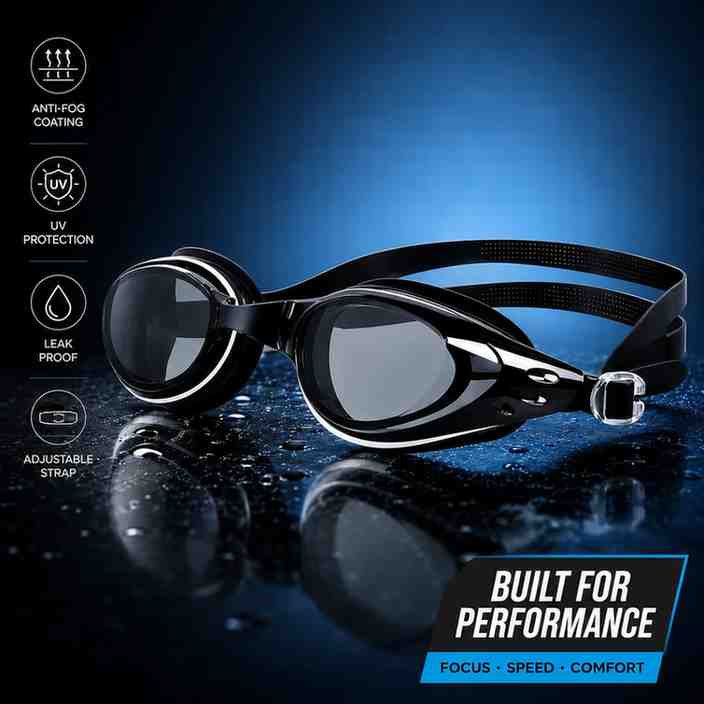
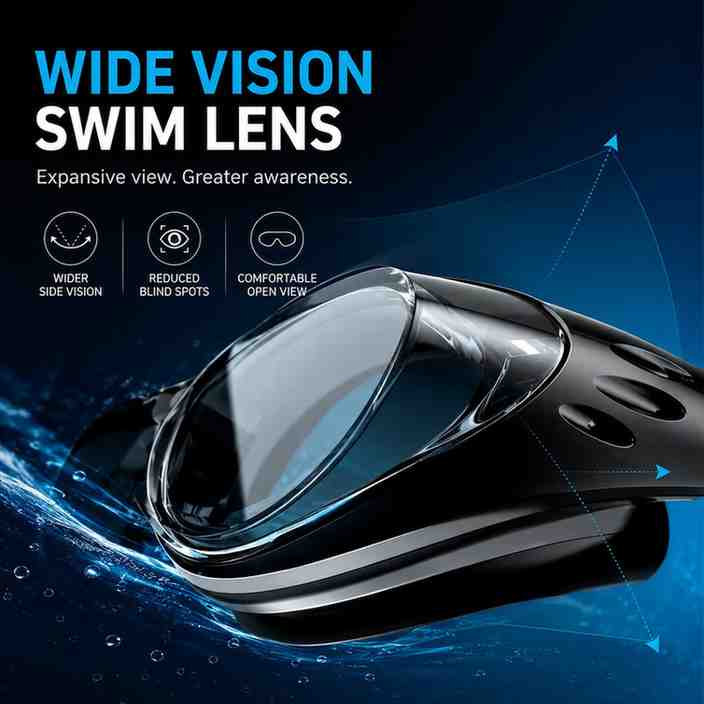
Prescription swimming goggles look similar to regular goggles, but there's significant optical engineering inside those lenses. Understanding how they work helps you choose the right product and have realistic expectations of what they can do.
How Normal Vision Works {#basics}
Your eye focuses light onto the retina using two main structures: the cornea (the clear dome at the front of your eye) and the crystalline lens (inside your eye). The cornea provides about 70% of your eye’s focusing power.
When the eye’s focusing system doesn’t perfectly focus light onto the retina, vision is blurry. Glasses and contact lenses correct these conditions by adding a precisely shaped lens in front of the eye that adjusts the path of incoming light.
Why Underwater Vision Is Naturally Blurry {#underwater}
The cornea works as a lens because there’s a large difference in refractive index between air (1.00) and corneal tissue (about 1.38). Water has a refractive index of 1.33 — much closer to the cornea’s 1.38. When your eye is in water, almost no bending of light occurs at the cornea. The cornea’s focusing power effectively disappears.
Even people with perfect vision see only blurry shapes underwater without goggles. This is physics, not a vision problem.
How Regular Goggles Help {#how-goggles-help}
Regular swimming goggles create a sealed pocket of air in front of each eye. This restores the air-cornea interface — your cornea is now surrounded by air as it is in everyday life, and can focus normally again.
🔬 Key Principle
Regular goggles = air pocket = cornea can focus normally. Prescription goggles = air pocket + corrective lens = cornea focuses normally AND your prescription is corrected.
How Corrective Power Is Added {#the-lens}
Prescription goggle lenses work identically to glasses lenses. The lens is shaped to a specific curvature that bends light by the exact amount needed to correct your vision.
- For myopia: concave lens (thicker at edges) diverges light rays, shifting the focal point back to the retina
- For hyperopia: convex lens (thicker in centre) converges light rays, shifting the focal point forward
- For astigmatism: toric surface with different curvatures in different orientations — the most complex shape, which is why not all goggle suppliers offer it
Making Prescription Goggle Lenses {#manufacturing}
Quality prescription goggle lenses are ground from lens blanks using computer-controlled surfacing equipment — the same technology used for glasses lenses. The prescription values (sphere, cylinder, axis) are programmed in, and the equipment shapes the lens surface to produce exactly that corrective power.
What Affects Optical Quality {#quality}
Lens Material: Polycarbonate is the standard. Higher-index materials (1.6, 1.67) are used for strong prescriptions to reduce lens thickness.
Prescription Precision: A lens ground to −2.75 will perform better for a −2.75 prescription than a stock −3.00 lens. This is why 0.25 dioptre precision matters — especially at moderate to strong prescriptions.
Cylinder Accuracy: Cylinder power must be matched to the correct axis. An error in axis even of a few degrees reduces the effectiveness of correction. Quality goggles match cylinder and axis precisely — a generic goggle won’t have any cylinder at all.
See the Difference for Yourself
Prescription goggles made to your exact specification — not round-number approximations. Adults and kids.
Adults Goggles Kids Goggles